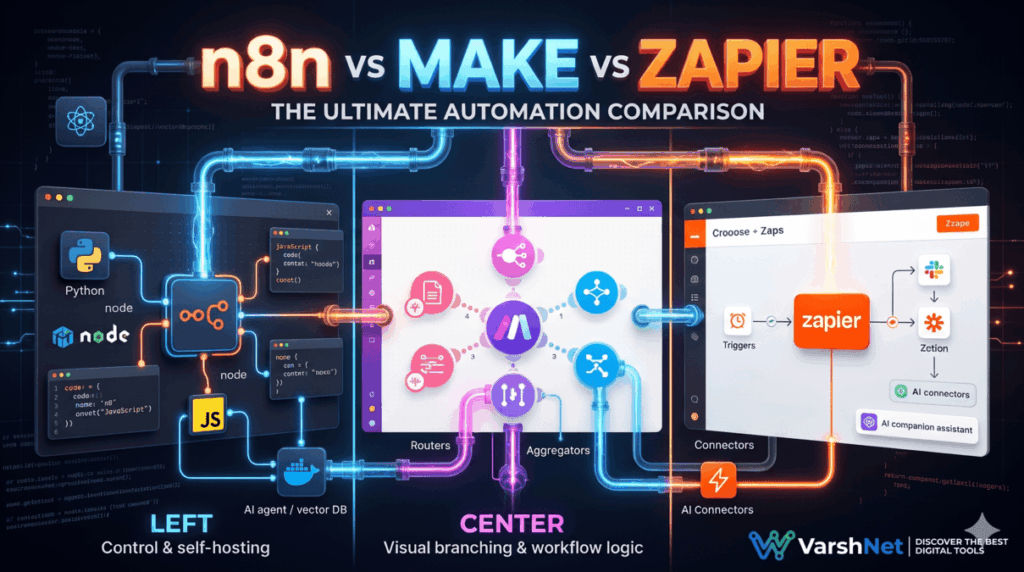
When choosing an automation platform, the n8n vs make vs zapier debate is the most critical decision you will make for your technology stack. While all three platforms link web tools together, their architectural approaches, cost models, and AI implementations are fundamentally different.
A workflow that costs $20 per month on one engine could easily cost $350+ per month on another as your data volume expands.
Below is an objective, technical head-to-head comparison examining execution math, data privacy, and AI agent capabilities.
Architectural Comparison Matrix
| Core Metric | n8n | Make | Zapier |
|---|---|---|---|
| Billing Model | Per Workflow Execution | Per Module Operation | Per Action Task |
| Hosting Options | Cloud or Self-Hosted (Docker/VPS) | Cloud Only | Cloud Only |
| Integration Count | 450+ native + community library | 3,000+ native modules | 7,000+ connectors |
| Coding Capability | Native JavaScript & Python nodes | Formula syntax & JSON parsing | Basic Code by Zapier (Python/JS) |
| AI Architecture | LangChain nodes, Memory & Agent graphs | Maia AI & OpenAI modules | Zapier Central & AI Agents |
| Starting Cost | Free (Self-Hosted) / $20/mo (Cloud) | Free / $9/mo (10k ops) | Free / $19.99/mo (750 tasks) |
1. The Cost Equation: Tasks vs. Operations vs. Executions
The most common trap in workflow automation is misunderstanding how platforms meter usage:
Zapier: Per-Task Billing
Zapier charges for every individual action step executed in a workflow.
- Example: A workflow triggers on a new lead, formats the phone number, checks a database, updates your CRM, and pings your team on Slack (4 action steps).
- If that flow runs 2,000 times a month:
2,000 × 4 = 8,000 tasks. - On Zapier, 8,000 tasks pushes you into higher-tier plans running between $100 and $200+ each month.
Make: Per-Operation Billing
Make counts every time a single module processes a bundle of data.
- While similar to Zapier’s model, Make’s base tiers are significantly cheaper ($9/month provides 10,000 operations).
- However, handling nested JSON payloads with iterators and arrays can generate multiple operations per record, consuming credits quickly if not carefully filtered.
n8n: Per-Execution Billing
n8n counts the entire end-to-end run as one single execution, regardless of whether the workflow has 2 nodes or 30 nodes, and regardless of how many records pass through it.
- That same 4-action lead workflow running 2,000 times equals exactly 2,000 executions.
- If you host n8n on a private VPS ($6–$12/month), your executions are completely unlimited with zero per-run fees.
2. Data Privacy and Infrastructure Control
- Zapier: Cloud-only. All data passes through Zapier’s managed cloud infrastructure. While certified (SOC 2 Type II, GDPR), companies with strict data residency rules or healthcare/financial mandates (HIPAA/BFSI) often cannot send sensitive customer records through external US cloud services.
- Make: Cloud-only, hosted within European and US regions. Excellent security standards, but workflows must remain within Make’s managed servers.
- n8n: The clear leader for data sovereignty. n8n offers an open-source, source-available Community Edition that runs locally, on bare-metal servers, or within a private cloud (AWS, Hetzner, DigitalOcean). Your API keys, customer database credentials, and transaction records never leave your infrastructure.
3. AI Capabilities & Autonomous Agents
All three engines have integrated artificial intelligence, but their depth varies significantly:
n8n (LangChain & Vector DBs)
n8n 2.0 features dedicated agentic architecture. It includes native LangChain nodes, support for memory persistence (Window Buffer, Redis), vector store connectors (Pinecone, Qdrant), and multi-agent coordination. You can build self-correcting agents that read unstructured inputs, consult company documentation, and execute multi-step database adjustments autonomously.
Make (Maia AI)
Make approaches AI through practical visual modules. Its Maia AI assistant helps users construct and troubleshoot scenarios visually, while its OpenAI/Anthropic modules make it straightforward to transform messy customer strings into clean JSON schemas.
Zapier (Zapier Agents & Central)
Zapier focuses on conversational no-code accessibility. Users can configure assistants using natural language prompts without structuring complex logic branches manually. It is ideal for teams wanting quick autonomous research or auto-drafted responses across their existing SaaS suite.
Direct Decision Guide: Which Should You Use?
Choose n8n if:
- You have basic technical skills or access to a developer.
- You run high-volume, multi-step automations where task-based pricing would become expensive.
- You need strict data privacy, local SQL connectivity, or on-premise execution.
- You want to build custom AI agents with vector memory.
Choose Make if:
- You want an affordable visual builder with first-class branching and router paths.
- You are not a programmer but are comfortable working with variables and webhook structures.
- You need intermediate-to-advanced automations without Zapier’s high per-task pricing.
Choose Zapier if:
- Speed of deployment is your top priority.
- You rely on multiple niche SaaS tools that lack community-built API integrations.
- You want a simple, linear builder that non-technical team members can maintain.
For a broader overview of other emerging automation platforms, read our full guide on the Top 5 AI Workflow Automation Tools for Small Businesses.